
The wave of PFAS litigation that has reshaped environmental law in the United States is beginning to reach Canadian shores. In 2023, 3M Company (formerly Minnesota Mining and Manufacturing Company) agreed to pay at least $10.3 billion to settle claims by American public water utilities,[1] and DuPont and its spinoffs agreed to an additional $1.185 billion settlement shortly after.[2] For Canadians, the obvious question is whether similar accountability is coming here. The short answer is: yes, but more slowly, and with a different cast of defendants leading the way.
This article surveys what we know about PFAS contamination in Canada, the legal actions already underway in Ontario and across the country, and what the structural differences between Canadian and American law mean for the scale and timeline of potential recovery.
What Are PFAS, and Why Do They Matter?
Per- and polyfluoroalkyl substances (PFAS) are a family of several thousand synthetic chemicals that have been manufactured and used extensively across industrial and consumer applications since the late 1940s.[3] They are valued for their extraordinary chemical stability — resistance to heat, water, oil, and degradation. That same stability and longevity is precisely what makes them a serious public health and environmental problem. PFAS do not break down in the environment or in the human body.
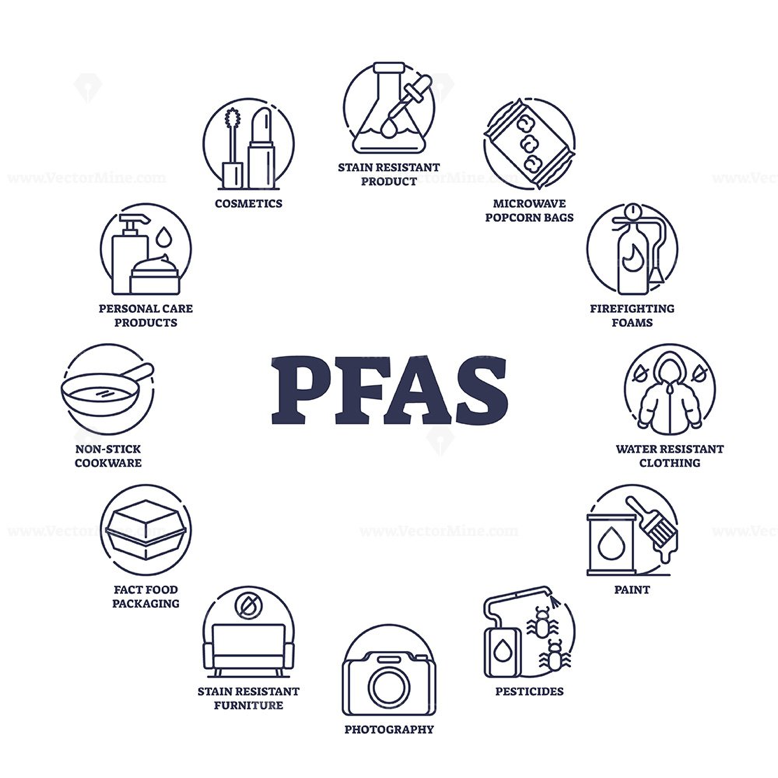
Common household items containing PFAS forever chemicals.
The two most studied compounds are perfluorooctanoic acid (PFOA), used as a processing aid in the manufacturing of TeflonÒ and other fluoropolymers, and perfluorooctane sulfonate (PFOS), the active ingredient in ScotchgardÒ and the primary component of aqueous film-forming foam (AFFF) used in firefighting. 3M began producing PFOS-based compounds in 1949; DuPont started using PFOA in TeflonÒproduction in 1951.[4] Exposure to PFOA and PFOS has been linked to kidney and testicular cancer, thyroid disorders, elevated cholesterol, pregnancy-induced hypertension, reduced vaccine response, and developmental effects in children.[5] Both companies had accumulated vast internal evidence of toxicity by the 1960s and 1970s — evidence that was not disclosed to regulators, workers, or the public for decades.[6] Therein lies the wrong requiring justice.[7]
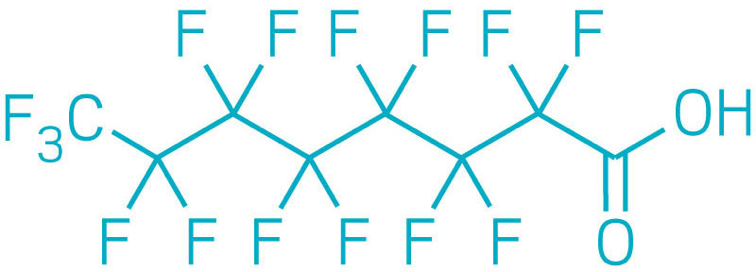
Chemical structure of Perfluorooctanoic acid (PFOA)
DuPont and 3M Operated Extensively in Ontario
A prerequisite for U.S.-style liability is a domestic footprint. That footprint clearly exists. DuPont Canada was a substantial subsidiary of the American parent company, with a significant employee base across multiple Ontario sites — including manufacturing plants at Maitland, Kingston, Whitby, Ajax, and Sarnia, and its head office in Mississauga.[8] The Maitland facility is of particular significance: corporate and tax litigation records confirm that a plant for the manufacture of fluorinated hydrocarbons was constructed in Maitland, Ontario, and that DuPont Canada’s Engineering Polymers and Fluorochemicals operations remained centred at that site.[9] This is the same category of manufacturing — fluorochemical production involving PFOA as a processing aid — that generated contamination and liability at DuPont’s Washington Works facility in Parkersburg, West Virginia.[10]
3M Canada Company also supplied PFAS-containing firefighting foams and other products throughout Canada for decades. Its AFFF foams were standard equipment at military bases, airports, and industrial fire training facilities across the country from at least the 1970s onward.
The current corporate entity, DuPont de Nemours, Inc. (established June 2019), maintains that it has never manufactured PFOA, PFOS, or firefighting foam. Through a legal fiction, it contends that the historical liability for those activities sits primarily with legacy entities, including the Chemours Company (spun off from DuPont in 2015), which holds a substantial portion of the environmental legacy.[11] Navigating that corporate reorganization — and the indemnity arrangements between successor entities — will be a central battleground in any Canadian litigation against the manufacturers.
Known Contamination Pathways in Canada
Military Bases and Airports — The dominant contamination pathway identified to date involves AFFF discharged at fire training facilities on federal property. PFAS are found or suspected on more than 100 federal sites in Canada, primarily from firefighting foam used by National Defence and Transport Canada from the 1970s to the early 2010s.[12] Contamination has been confirmed at airports and military bases across the country.
Fluorochemical Manufacturing — The DuPont Maitland plant represents a potential industrial source analogous to U.S. contamination cases. Peer-reviewed research on Ontario watersheds has confirmed PFAS contamination from electroplating, circuit board manufacturing, and commercial laundry and carpet-cleaning operations — all industries that relied on 3M and DuPont PFAS-containing products. Health Canada in August 2024 set a group-based threshold of 30 ng/L for 25 PFAS compounds.[13]
Consumer Products Supply Chain — TeflonÒ cookware, ScotchgardÒ-treated textiles, food packaging, waterproof clothing, and firefighting-related products all represent exposure and contamination pathways. While personal injury litigation on these grounds is less developed in Canada than in the U.S., the factual predicate — widespread exposure combined with documented corporate concealment — is consistent with what has driven U.S. litigation and settlements.
Canadian Litigation: What Is Already Happening
In the last five years, PFAS litigation has moved from nearly non-existent in Canada to a growing body of class actions with significant potential scale. The following matters are among the most notable:
Egan v. National Research Council of Canada (Ontario) — In 2021, the Ontario Superior Court of Justice certified a class action brought by 69 adjacent property owners against the National Research Council of Canada (NRC), arising from PFAS contamination of groundwater near the NRC’s National Fire Laboratory in Mississippi Mills, Ontario.[14] The NRC had used the site for fire safety research and testing of AFFF from 1981 to 2016. In a landmark ruling on March 9, 2026 (2026 ONSC 1429), the Court certified punitive damages as a common issue — the first time in Canadian legal history that punitive damages have been certified against the federal government in a PFAS drinking water contamination class action. The Court found a sufficient evidentiary basis that the NRC’s approximately 2.5-year delay in notifying residents of contamination it had detected as early as 2009 could constitute “malicious, oppressive and high-handed” conduct. The punitive damages claim is $2 million; the compensatory claim for property stigma is $40 million.[15]
Lynch v. 3M et al. (Ontario, 2024) — A proposed class action filed against 3M, DuPont, and other defendants directly, alleging that the defendants were aware of the risks PFAS posed to human health and the environment but continued to manufacture and distribute these chemicals, resulting in contamination of drinking water systems. This is the closest Canadian analogue to the multi-district litigation that drove the major U.S. settlements.[16]
British Columbia Government Action (2024) — On June 21, 2024, the B.C. government filed a proposed class action against 3M, DuPont, Tyco, and BASF in their capacities as manufacturers, marketers, and distributors of PFAS-containing products, including AFFF. The action follows B.C.’s prior litigation against tobacco companies and opioid manufacturers.[17]
Newfoundland (St. John’s International Airport) — A proposed class action on behalf of residents whose private wells are contaminated with PFAS from a Transport Canada-operated firefighting training facility. Groundwater testing has identified PFAS concentrations exceeding Health Canada’s 30 ng/L objective in wells up to 3.5 km from the source. The federal government has filed third-party claims against 3M and Mueller Water Products — a tactic that may force evidentiary disclosure from the manufacturers.[18]
North Bay, Ontario — A proposed class action involving claims related to PFAS contamination from CFB North Bay and the Jack Garland Airport, advancing alongside the Egan litigation as part of the emerging body of property-value stigma class actions across Ontario.[19]
The overall trend is unmistakable. Environmental class action filings in Canada doubled in 2025, with PFAS actions representing a significant share of that growth.
The Regulatory Foundation Is Being Built
Civil litigation and regulatory classification tend to move in parallel. In Canada, the regulatory framework is advancing, and that advancement matters for establishing the standard of care in civil proceedings.
On March 5, 2025, Environment and Climate Change Canada and Health Canada published the Final State of PFAS Report, concluding that the class of PFAS — excluding fluoropolymers — meets the criteria for toxicity under paragraphs 64(a) and 64(c) of the Canadian Environmental Protection Act, 1999 (CEPA). A proposed Order adding PFAS to Part 2 of Schedule 1 to CEPA was published in the Canada Gazette on March 8, 2025.[20] Adding a substance to CEPA Schedule 1 enables the federal government to enact enforceable risk management measures.[21]
The contrast with the United States is legally significant: the U.S. EPA’s designation of PFOA and PFOS as hazardous substances under CERCLA (the federal Superfund statute) in April 2024 created a direct strict liability mechanism for remediation costs that has no Canadian equivalent.[22] The absence of a CERCLA-like provision is one reason Canadian PFAS litigation has focused more heavily on negligence, nuisance, and property damage claims than on regulatory enforcement-driven recovery.
Structural Differences: Why Canadian Recoveries Will Look Different
The U.S. settlements are extraordinary both in their scale and in the speed with which they were reached. Several structural features of Canadian law mean that comparable outcomes are possible but will likely take longer and produce different results.
Limitation Periods — Manufacturers will attempt to avoid liability by citing Ontario’s Limitations Act, 2002which provides a general two-year discovery-based limitation period.[23] For PFAS, the discoverability question — when did the plaintiff know, or ought to have known, of the contamination and its source — is contested. Defendants may argue that widespread media coverage of PFAS risks triggered the clock earlier than plaintiffs prefer. The certification decisions in Egan signal that courts are not treating this as a simple bar to recovery, but it will remain a live issue in each case.
No Superfund Equivalent — The United States CERCLA statute imposes strict, joint and several liability for remediation costs at designated hazardous sites, providing a powerful lever that does not exist under Canadian federal law. Canadian plaintiffs rely primarily on common law causes of action: negligence, nuisance, trespass, and — in appropriate cases — the rule in Rylands v. Fletcher and the tort of knowing concealment.
Corporate Reorganization — The current DuPont de Nemours entity maintains that it has never manufactured PFOA or PFOS. The historical liability sits primarily with Chemours and the legacy DuPont entities.[24] Plaintiffs must navigate corporate reorganizations, indemnity arrangements, and successor liability principles to reach the entities with financial responsibility for the historic conduct.
Class Action Mechanics — Ontario’s Class Proceedings Act, 1992 provides a certification framework that is generally accessible to plaintiffs.[25] The Egan certification demonstrates that PFAS property damage claims can meet the commonality and preferable procedure requirements. Personal injury class actions — which would require more individualized causation evidence — face higher certification hurdles and have not yet been filed in Canada at scale.
Damages Scale — Canada’s smaller population base and the geographic concentration of identified contamination sites means the absolute dollar value of Canadian settlements will be considerably smaller than their American counterparts, even if liability is established on comparable legal principles.
Who Is Most Likely to Have Viable Claims?
Based on the litigation landscape as it stands today, the most viable categories of claimants in Canada are:
- Property owners near known AFFF discharge sites — particularly those adjacent to current or former military bases, airports, and fire training facilities where National Defence, Transport Canada, or municipal fire services discharged PFAS-containing foams. Property value stigma and groundwater contamination are the primary damages available.
- Municipal water utilities — analogous to the American water system plaintiffs who drove the 3M and DuPont settlements. If a Canadian water utility can demonstrate that its treatment infrastructure required or will require upgrade to address PFAS, a claim against the manufacturers is legally coherent.
- Firefighters and military personnel — occupational exposure claims for individuals who regularly handled AFFF are already being advanced in Canada. These claims require individualized medical causation evidence but benefit from the documented connection between AFFF exposure and specific cancer types.
- Residents near industrial fluorochemical manufacturing sites — including communities in proximity to the former DuPont Maitland operations, which have not yet been the subject of specific litigation but represent a logical extension of the American contamination cases.
Update: Australia Sues 3M for AU$2 Billion — A Precedent Worth Watching
Just days before this post published, the Australian government filed the largest compensation claim in its history: a AU$2 billion (approximately CAD$1.8 billion) lawsuit against 3M Company and its Australian subsidiary, lodged in the Federal Court of Australia on May 28, 2026.[26] The action relates to PFAS contamination at 28 Australian Defence Force bases resulting from the historic use of 3M’s AFFF firefighting foam. The Australian Department of Defence had already spent AU$1.3 billion remediating the contamination before the lawsuit was filed — removing more than 200,000 metric tonnes of contaminated soil and treating over 13 billion litres of contaminated water.[27]
The legal theory is deliberately narrow. The complaint does not rely on personal injury or human health effects — a deliberate strategic choice that sidesteps the more contested areas of PFAS toxicology and focuses the claim on the cleanest available cause of action: the economic cost of a cleanup the government alleges it was deceived into bearing.[28] The complaint alleges that 3M gave assurances about the foam’s safety and biodegradability while withholding its own internal testing that pointed to significant adverse environmental effects.[29]
3M disputes the allegations. The company notes that it never manufactured PFAS in Australia and ceased sales of AFFF products there around 2005, and points out that the Australian Defence Department continued to use the foam for nearly two decades after that date. 3M has signalled it will defend the claim vigorously.[30] Large PFAS lawsuits of this kind have historically settled before trial to avoid damaging disclosure and adverse judgements.
The Australian case is relevant to the Canadian litigation landscape for several reasons. First, the factual premise is structurally identical to the strongest Canadian PFAS cases: government-operated military sites, prolonged AFFF use, contamination of surrounding land and groundwater, and a claim grounded in what the manufacturer knew and what it withheld from disclosure. The Canadian federal government has followed a similar theory in the Newfoundland action, filing third-party claims against 3M. Second, the Australian case demonstrates that sovereign governments — not just private plaintiffs — can mount credible, large-scale cleanup cost claims against PFAS manufacturers. Third, 3M’s core defence — that it ceased sales before most of the contamination occurred, and that the government continued using the product — is exactly the argument that Canadian defence counsel would deploy. How the Federal Court of Australia evaluates the “knew or ought to have known” standard and apportions responsibility between manufacturer and purchaser will be closely studied by litigators on both sides of potential Canadian proceedings.
The international momentum is building. The U.S. settlements. The Dutch and Belgian Chemours rulings. The New Jersey DuPont/Chemours settlement. And now Australia. Canada is not operating in a vacuum. Each foreign judgment and settlement strengthens the evidentiary record of manufacturer knowledge and concealment that Canadian plaintiffs — and potentially the Canadian Government — would rely on in domestic proceedings.
The Takeaway
The PFAS litigation wave is not simply an American phenomenon. It is a global reckoning. It reflects decades of documented corporate concealment, widespread industrial contamination, and regulatory underreaction that was characteristic of the Canadian experience every bit as much as the American or Australian one. DuPont and 3M operated significant fluorochemical manufacturing and distribution operations in Ontario. The federal government used their products at military and transport sites across the country for decades. The science linking PFAS exposure to serious health effects continues to strengthen, and the regulatory framework is evolving to reflect it.[31]
The scale of Canadian recovery may not approach the multi-billion dollar American settlements. But the legal foundation for significant class action recoveries — in Ontario and across Canada — is clearly being laid. The March 2026 punitive damages certification in Egan signals that Canadian courts are prepared to treat the concealment and delay issues seriously, not simply the underlying contamination. The Lynch v. 3M action, if certified, will test whether manufacturer-direct liability can be established here on terms comparable to what American plaintiffs achieved. And the Australian lawsuit — filed by a peer common law government on nearly identical facts — gives Canadian policymakers and litigators a live procedural template to work from.
For communities near affected sites, the message is that legal options exist and are being actively pursued. For companies with legacy PFAS manufacturing or distribution operations in Canada, the message is that the exposure is real, growing, and now attracting coordinated attention from governments and sophisticated class action counsel on multiple continents.
This post is provided for general informational purposes and does not constitute legal advice. If you believe you or your property may have been affected by PFAS contamination, you should seek independent legal advice specific to your circumstances.
Daniel Nashid
Barrister & Solicitor
700 Bay Street
Suite 405
Toronto, ON M5G 1Z6
[1]3M Company press release, June 22, 2023; see also Associated Press, “3M to pay $10.3 billion for settlement over contamination of water systems” (June 22, 2023).
[2]DuPont, Chemours and Corteva press release, June 2023; reported in Associated Press, “DuPont, Chemours and Corteva to pay nearly $1.2 billion over PFAS water contamination” (June 2023).
[3]U.S. Environmental Protection Agency, “Per- and Polyfluoroalkyl Substances (PFAS)” (EPA PFAS overview page). See also 3M announcement, May 16, 2000: EPA and 3M Announce Phase Out of PFOS.
[4]In 1949, 3M began producing PFOS-based compounds by electrochemical fluorination: see EPFL chemical database entry on perfluorooctanesulfonic acid (PFOS), citing peer-reviewed literature. DuPont began using PFOA to manufacture Teflon in 1951: U.S. EPA, “Chemours Washington Works History and SDWA Settlements” (EPA site).
[5]U.S. EPA, “Health Effects of PFAS,” available at https://www.epa.gov/pfas/pfas-explained; Agency for Toxic Substances and Disease Registry (ATSDR), “Per- and Polyfluoroalkyl Substances (PFAS) and Your Health” (2022).
[6]U.S. EPA press release, May 16, 2000: “EPA and 3M Announce Phase Out of PFOS” (noting 3M data supplied to EPA showed chemicals “are very persistent in the environment, have a strong tendency to accumulate in human and animal tissues and could potentially pose a risk to human health and the environment”).
[7] DuPont’s wrongdoing was especially egregious, first entering public consciousness as a result of Mr. Robert Bilott’s diligent work as summarized in 2016 New York Times Magazine feature: “The Lawyer Who Became DuPont’s Worst Nightmare”; inspiring the 2019 feature film “Dark Waters”.
[8]The Canadian Encyclopedia, “E.I. DuPont of Canada Company (DuPont Canada)”.
[9]See also McLennan Ross LLP, “From Non-Stick to Non-Stop Litigation: The Growth of PFAS Litigation and Regulatory Enforcement” (February 2026), citing corporate restructuring records confirming DuPont Canada’s Fluorochemicals operations at Maitland, ON.
[10]U.S. EPA, “Chemours Washington Works History and SDWA Settlements”.
[11]DuPont de Nemours, Inc. was established June 1, 2019 following the Dow DuPont merger and subsequent spinoffs. Chemours Company was spun off from E.I. du Pont de Nemours in 2015. See DuPont corporate history.
[12]Government of Canada, “Per- and polyfluoroalkyl substances and aqueous film-forming foam used in firefighting” (canada.ca). See also CBC News / Globe and Mail national PFAS site mapping (2024–2025), publicly reported.
[13]Health Canada, Interim Objective for Canadian Drinking Water Quality: Per- and Polyfluoroalkyl Substances (PFAS) (August 9, 2024), available at https://www.canada.ca/en/health-canada/services/environmental-workplace-health/reports-publications/water-quality/per-polyfluoroalkyl-substances.html.
[14]Egan et al. v. National Research Council of Canada et al., 2021 ONSC 4561 (CanLII), available at https://canlii.ca/t/jgvsg.
[15]Egan et al. v. National Research Council of Canada et al., 2026 ONSC 1429. See Mann Lawyers LLP, “Environmental Class Action Legal First: Punitive Damages Certified Against Federal Government for Delay in PFAS Drinking Water Contamination Disclosure” (March 26, 2026).
[16]McLennan Ross LLP, “From Non-Stick to Non-Stop Litigation: The Growth of PFAS Litigation and Regulatory Enforcement” (February 2026). The action is a proposed class proceeding filed in Ontario.
[17]Osler, Hoskin & Harcourt LLP, “B.C.’s forever litigation: first tobacco, then opioids, now ‘forever chemicals’” (June 27, 2024).
[18]Dragun Corporation, “The Elevated PFAS Liability in Canada” (March 2026); Mann Lawyers LLP, “PFAS in Canada: From Drinking Water Contamination to Class Action Litigation” (November 2025).
[19]Mann Lawyers LLP acts for plaintiffs in Sway and Currie v. The Attorney General of Canada and the Corporation of the City of North Bay, Ontario Superior Court of Justice. See Mann Lawyers LLP, “Environmental Class Action Legal First” (March 2026).
[20]Environment and Climate Change Canada and Health Canada, State of Per- and Polyfluoroalkyl Substances (PFAS) Report(March 5, 2025); proposed Order published in Canada Gazette, Part I, Vol. 159, No. 10 (March 8, 2025). Available at https://www.canada.ca/en/health-canada/services/chemical-substances/fact-sheets/chemicals-glance/per-polyfluoroalkyl-substances.html.
[21]Government of Canada, “Risk Management Approach for Per- and Polyfluoroalkyl Substances (PFAS), Excluding Fluoropolymers” (canada.ca, March 2025).
[22]U.S. EPA, “PFAS Designated as Hazardous Substances Under CERCLA”. PFOA and PFOS were designated as CERCLA hazardous substances in April 2024.
[23]Limitations Act, 2002, S.O. 2002, c. 24, Sched. B, s. 4 (basic limitation period: two years from discovery). Available on eLaws Ontario at https://www.ontario.ca/laws/statute/02l24.
[25]Class Proceedings Act, 1992, S.O. 1992, c. 6. Available on eLaws Ontario at https://www.ontario.ca/laws/statute/92c06.
[26]Commonwealth of Australia, Federal Court of Australia, Statement of Claim filed May 28, 2026 (Commonwealth of Australia v. 3M Company and 3M Australia Pty Ltd). Attorney-General Michelle Rowland press conference, May 28, 2026, as reported by AP: “Australia sues 3M for more than $1.4 billion over alleged ‘forever chemical’ contamination” (Fortune / AP, May 28, 2026).
[27]Assistant Defence Minister Peter Khalil, press conference, May 28, 2026 (“Defence has spent over $1.3 billion on its PFAS response”), as reported in Law Society Journal (Australia): “Federal Government sues 3M for over $2 billion over PFAS contamination at defence bases”.
[28]Peter Khalil radio interview, May 28, 2026, as quoted in ICLG: “it is ‘important to remember that this action doesn’t relate to personal injury or any human health effects alleged to have been impacted by PFAS exposure’ and is ‘very much focused on recovering AU$2 billion.’” See Australia launches AU$2 billion PFAS lawsuit against 3M.
[29]The Conversation, “Australia’s huge ‘forever chemical’ lawsuit focuses on the cleanup – not human health. Why?” (June 2026); Eastern Herald, “Australia Sues 3M for $1.4 Billion Over PFAS Forever Chemicals” (May 28, 2026).
[30]3M Company statement, May 28, 2026: “3M has never manufactured PFAS in Australia and ceased sales of the products at issue in Australia around two decades ago.” As reported by AP (see footnote 24 above) and ICLG, “Australia launches AU$2 billion PFAS lawsuit against 3M” (May 28, 2026).
[31]Osler, Hoskin & Harcourt LLP, “Forever chemicals, forever liability? The rise of PFAS class actions in Canada” (May 2026).